Place as atmospheric inheritance
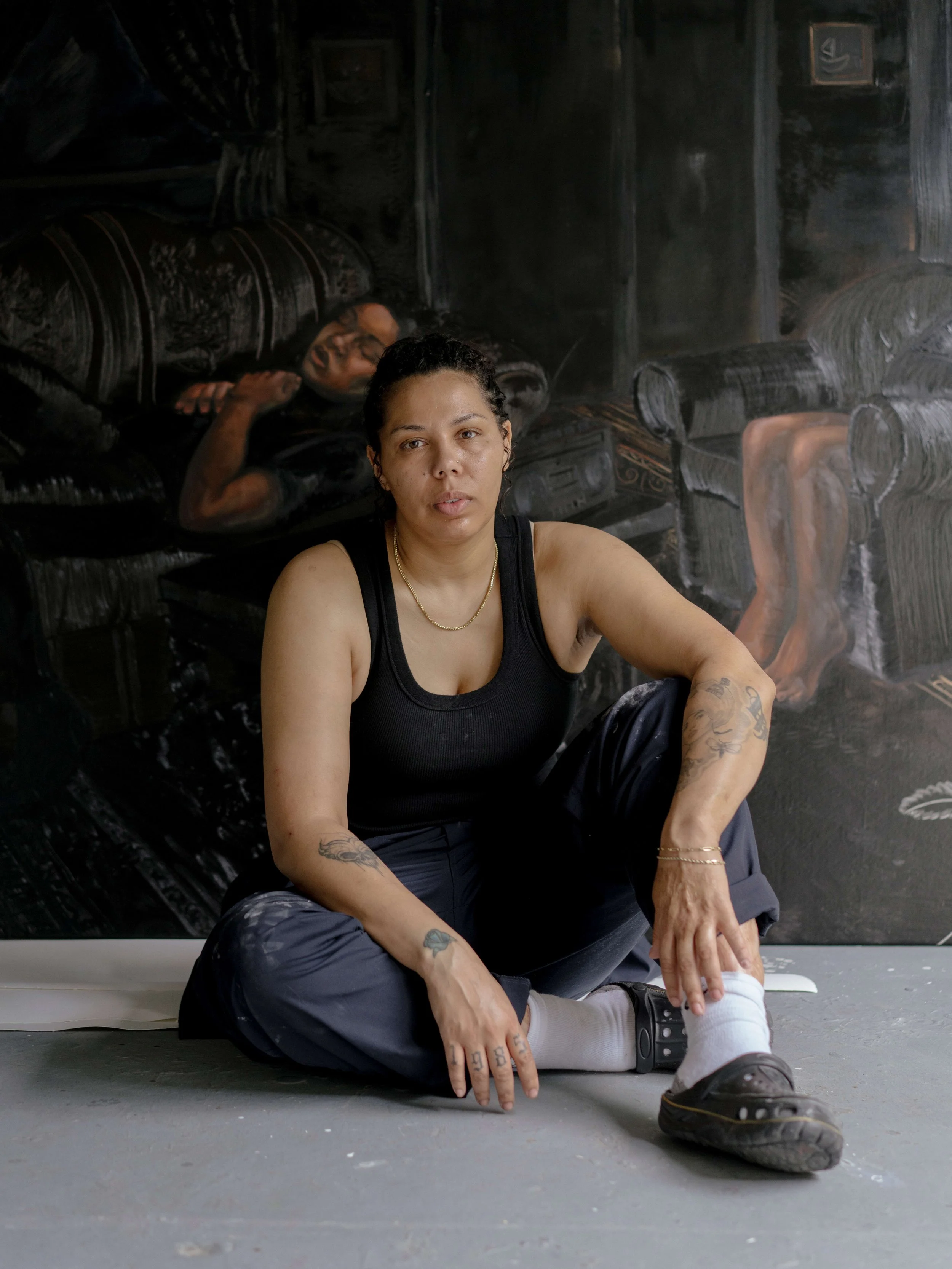
Natia Lemay works across painting and sculpture to consider how atmospheric inheritances shape our relationships to bodies, objects, space and place. Moving between interior and geographical sites, her work attends to the conditions that gather around us and the ways they alter how we perceive, occupy and move through space. Light becomes a form of orientation within the work, revealing what is present, what has been, and what might still be there.
Black is both material and atmosphere within Lemay’s paintings. Built through an evolving collection of more than forty chromatic blacks in oil and acrylic, the surfaces shift between matte and gloss, opacity and luminosity, texture, glazes and washes. Colour is largely held within the skin of the figures, while black constructs the spaces around them. Rather than functioning as darkness or void, black becomes active and mutable, absorbing and reflecting light while allowing forms to emerge, recede and change according to the viewer’s position.
Bodies, objects and architectural fragments appear within these fields without settling into fixed relationships. Interior spaces extend toward larger questions of geography and place, while familiar objects become points of contact between lived experience and inherited conditions. Through painting and sculpture, Lemay considers space not as a passive setting but as something felt and negotiated, a material condition through which bodies find proximity, distance, orientation and relation.
Research Notes
Autoethnography as method
Atmospheric inheritance
Black spatial thought
Black consciousness and interiority
The afterlives of slavery
Light as orientation
Phenomenology and perception
Memory of place
Interior and geographical space
The home as site
Domestic architecture
Black geographies
Bodies in relation to built environments
Objects as carriers and witnesses
Presence / absence
Proximity / distance
Opacity / luminosity
Surface / depth
Thresholds and transitional spaces
Migration and displacement
Diaspora and belonging
Black Canadian histories
Black American histories
The Black Atlantic
Colonial geographies
Surveillance and the racialized body
Race, class and the construction of place
Social structures and the everyday
Family photographs and personal archives
Oral histories
Inherited and lived histories
Site-specific histories
What remains
What is carried
What becomes visible